Trading Psychology — Replace Willpower with Procedure
Published 2026.07.01 · Updated 2026.07.06
Anyone searching for 'trading psychology' has usually just carved a chunk out of their account with an impulsive trade and is looking for a way to never do it again. The trouble is that the standard answer — 'master your emotions' — is a prescription with a proven track record of failure: emotions can't be mastered, and they don't need to be. This piece starts from the opposite premise. It breaks down the triggers that set off loss aversion, FOMO, and revenge trading, then covers rule design that finishes every decision before emotion can reach the order button, and a trading journal method that verifies it all with data. Discipline is a matter of design, not personality.
- Loss aversion is a wiring problem, not a knowledge problem. Prospect theory's observation that a loss feels roughly twice as large as an equal gain drives delayed stops and premature profit-taking — and it repeats even when you know about it.
- FOMO, revenge trading, and profit impatience each run as a loop of trigger, inner sentence, and action. Once you know the loop, you can design one counter-rule paired to each link.
- The core of discipline is moving the timing of decisions. Devices like a fixed setup list, 1R, pre-placed stop orders, and a daily halt limit enforce decisions made before emotion arises, in a form that can't be broken.
- A trading journal grades adherence, not P&L. Separate the R totals of trades that followed the plan from trades that broke it, and the reason to keep your rules stops being someone else's advice and becomes your own data.
Why Psychology Beats Your Account — The Math of Loss Aversion
The starting point is measured data from psychology. Kahneman and Tversky's Prospect Theory experiments repeatedly observed loss aversion: for the same dollar amount, the pain of a loss feels roughly twice as intense as the pleasure of an equal gain. That asymmetry produces two chronic trader behaviors. Losing positions get held, because cutting them 'makes the pain final,' while winning positions get closed in a hurry to 'lock in the joy before it disappears.' Behavioral finance calls this pattern the Disposition Effect, and it executes the textbook principle — cut losses short, let winners run — exactly backwards.
Put it in numbers and the problem comes into focus. Say a trader with a $10,000 account, allowing 1% ($100) per failed trade, takes a BTC long at $100,000 with a planned stop at $98,000 (-2%). The moment price touches the stop level, a sentence intervenes: 'if I cut here, the loss becomes final.' At $95,000 it's 'it's come this far, it has to bounce'; at $92,000 it's 'it's too far down to cut now.' The planned -2% becomes -8%, and the $100 allowance becomes $400. The plan was -1R, the realized result -4R — not because the analysis was wrong, but because our emotional structure is wired so that the very act of following the plan hurts.
A -10% loss takes +11% to recover, but -20% takes +25%, and -50% takes +100%. Delaying a stop is dangerous not simply because you lose big once, but because it pushes your account onto this curve, where the return needed to reach break-even accelerates the deeper you go. It's the path by which a psychology problem turns into an arithmetic problem.
The important conclusion is this: loss aversion keeps working even when you know about it. Memorizing the name of a bias and blocking its execution are different problems, and the latter belongs to procedure, not knowledge. The rest of this piece is entirely about that procedure.
The Emotion Cycle — Buying in Euphoria, Selling in Despair
When individual biases aggregate, they become the market's collective emotion cycle. On the curve that climbs from optimism to excitement to euphoria, then descends through anxiety, denial, and fear into despair, the key point is that emotion is a lagging indicator of price. Euphoria only arrives after the rally has already run long, and despair only arrives after the decline has largely been absorbed. The moment the crowd's conviction peaks tends to coincide with the moment the least new money remains to enter in that direction — conviction maxes out precisely when everyone who was going to buy already has.
The practical use of this cycle isn't predicting direction — it's diagnosing your own position on the curve. The diagnostic questions are simple. If you want to brag about a position and you're screenshotting your profits, odds are you're in the euphoria zone. If you're attaching reasons to the decline while insisting 'this time is different,' that's denial. If you can't bring yourself to open the chart, you're somewhere between fear and despair. Once you know where you are, the move is not to trade against the crowd — that's just another prediction — but to accept that the higher the emotional intensity of the zone, the higher the odds you'll break a rule, and cut both size and trade frequency accordingly.
Emotion can't be eliminated. All you can do is cut the path it takes to the order button.
The Three Destroyers — How FOMO, Revenge Trading, and Profit Impatience Operate
The emotional trades that wreck accounts look like they come in many varieties, but broken down, three loops keep repeating. Each runs in the order trigger → inner sentence → action. First, FOMO. The trigger is a ripping candle and a community timeline, the sentence is 'it's now or never,' and the action is a market-order chase that was never in the plan. There's a structural reason it's a losing spot — right after a vertical move, volatility expands and the distance to a meaningful invalidation level widens, so keeping the same 1R actually requires reducing size there. FOMO makes you increase size in exactly that spot, and because the entry rationale is 'the rally itself,' the rationale evaporates the moment the rally stalls — leaving you with no stop criterion at all.
Second, revenge trading — the most destructive form of impulse trading. The trigger is the loss you just took, the sentence is 'I'll win it right back,' and the action is re-entering the same coin immediately after the stop with bigger size. Run the arithmetic: a trader who sets 1R at 2% of the account stops out at -1R, re-enters at double size 'to recover fast,' and stops out again — that adds -2R for a total of -3R, or -6% of the account. Double once more in anger and you're at -7R inside a single day. Trading to win back a loss is a structure that multiplies the speed of loss, and with leverage stacked on top, the terminus is forced liquidation.
Third, profit impatience. The trigger is a wobble in unrealized profit; the sentence is 'lock it in before it disappears.' Why this counts as a destroyer shows up in the math. Suppose you've fallen into the habit of closing a setup designed with a -1R stop and a +3R target at +0.5R every time. Assume it's a setup where 4 trades out of 10 reach the target: run by the plan, the total is 4×3R − 6×1R = +6R, but with the early exits it's 4×0.5R − 6×1R = -4R. Same entries, same hit rate — a single profit-taking habit flips the sign. It's loss aversion operating on the profit side.
All three are identical in that they let the emotion created by the previous event decide the size and timing of the next order. The last spike creates the entry (FOMO), the last loss creates the size (revenge trading), and the last wobble creates the exit (impatience). The shorter the gap between trades, the worse this contamination gets — why the overtrading loop is uniquely dangerous in short-timeframe trading is covered separately in the scalping guide.
Procedure, Not Willpower — Designing Rules That Replace Emotion
There are three design principles. First, move the timing of decisions. Shift every decision about entries, stops, size, and stopping for the day to before the emotion exists — when the market is quiet, when you hold no position. Behavioral economics calls this device pre-commitment. Second, a rule you can break is not a rule. A resolution to 'cut when it hits' is nothing but a wish in the face of loss aversion, so convert resolutions into standing orders and resolve into hard limits that enforce themselves. Third, pair rules to emotions — one blocking rule per destroyer, with a clear answer to which link in the loop it cuts.
- A fixed setup list — Keep only setups with defined conditions, entry, invalidation, and target, documented in writing, and classify anything not on the list not as an 'opportunity' but as 'not a trade.' This is the rule that blocks FOMO's entry path.
- Fixed 1R and back-calculated size — First set the amount you'll allow per failed trade as a % of the account, then back-calculate quantity from the stop distance (the formula from the risk management guide). It reduces emotion's share of the sizing decision to zero.
- Pre-placed stop orders — Place the stop order in the same moment as the entry order. Execution exists before emotion does, which removes the very moment loss aversion could intervene.
- A daily halt limit — At -2R on the day, or after two consecutive stop-outs, trading is over for the day. Revenge trading isn't resisted with willpower — you cut off its fuel (further chances to trade).
- A re-entry waiting rule — After stopping out of a coin, re-enter only once a minimum waiting period has passed and a fresh setup condition is met again. It procedurally separates 'win it back' entries from 'new evidence' entries.
- Rule changes on weekends only — Add, relax, or delete rules only during a scheduled review with no position open. Editing rules mid-session is just violation by another name.
The most common failure in rule design comes not from having too few rules but from having too many. When unkeepable rules pile up, violations become routine, and once violations are routine, the authority of the rules that truly matter (stops, limits) collapses with them. Delete the rules you keep breaking, or convert them into unbreakable forms like pre-placed orders and hard limits. Three rules you keep are stronger than ten rules you break.
The Trading Journal — A Tool That Turns Emotion into Data
The purpose of a trading journal is data collection, not a written confession. And what it grades is adherence, not P&L. A trade you lost while following the plan is a normal cost that gets recovered as the sample grows; a trade you won while breaking the plan is an event that rewarded a habit destined to end your account someday. That distinction has to survive in the record for discipline to become measurable.
- Setup name — Which setup on the list was it? If you can't name one, that itself is a record that the trade was off-list.
- The 3 planned numbers — Entry price, invalidation price, target price. Written down before entry.
- Actual fills — Actual entry and exit prices, and how they differed from the plan.
- Result in R — Log the P&L converted into R units, not a dollar amount.
- Adherence grade — A for by the plan, B for a partial violation, C for an off-plan trade.
- Emotion tag — Your state at the moment of entry: FOMO, revenge, impatience, or calm.
The analysis takes two lines at month-end. Total the R of A-grade trades and the R of C-grade trades separately. Most traders go through the moment of confirming, for the first time in their own numbers, that the C total is negative — and at that moment, the reason to follow the rules changes from 'someone else's advice' to 'my own data.' Add an R total per emotion tag and your most frequent destroyer gets identified — FOMO for some, revenge trading for others — and the following month, you concentrate on reinforcing just the one rule aimed at that emotion.
Log the limitations honestly, too. First, psychological discipline cannot save a strategy with negative expectancy. Repeat an edgeless setup with perfect discipline and you will simply lose precisely, slowly — discipline is a necessary condition, not a sufficient one. Second, self-reported data gets distorted. Violating trades are the ones most likely to go unlogged, so you need a correction rule that treats a missing record itself as a C grade. Third, with a small sample, even the A/C comparison is noise — withhold conclusions until the count reaches the dozens. And no journal removes the possibility of losing your entire principal in a leveraged market (what is liquidation?).
The Whale Story Data — Crowding, in Numbers
FOMO is an emotion you experience alone, but at the collective level it's a measurable phenomenon. During vertical rallies, market buys pile onto the large-trade tape of the live tracker, and once a rally enters its exhaustion phase, overheating readings register on the suspected-top signals. By the time your own urgency switches on, the crowd's urgency has usually already printed in the data — the measured version of the emotion cycle's 'emotion trails price.'
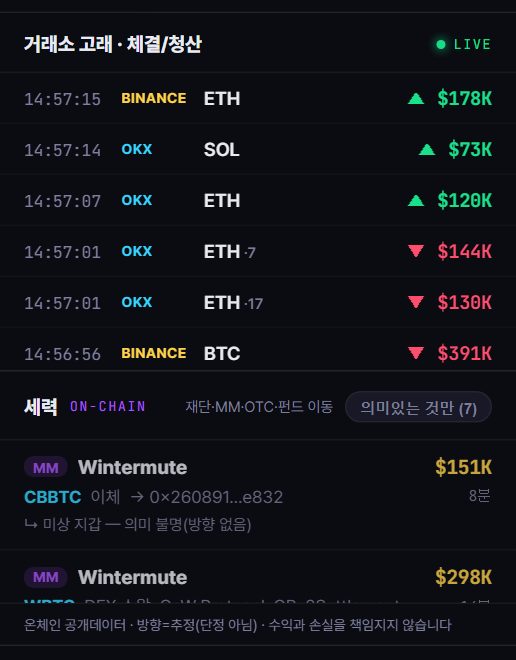
Check before you order. ① Look at the signals page to see whether the coin is flagged as a suspected rally top — if it is, your current conviction may be the classic emotion of an exhaustion phase. ② Check the trade tape to see whether large buys are still coming through or have gone quiet. ③ Cross-reference the smart-money tracker to see what verified wallets are doing in the same zone. The purpose of this procedure isn't to outsource the entry decision — it's to insert one verification step between the emotion and the order.
In the end, this piece has one conclusion. The traders who last aren't the ones without emotions — they're the ones who built, in advance, procedures that emotion cannot reach into. The skeleton of that procedure, 1R and sizing, continues in the risk management guide, and the high-frequency environment where procedure breaks down most often is covered in the scalping guide.
An individual's FOMO can't be observed, but the crowd's FOMO prints in numbers on Whale Story. The large-trade tape of the live tracker records, in every vertical rally, the scene of market buys crowding in, and the suspected-top signals capture the overheating readings that appear once a rally enters its exhaustion phase. In past observations, the zones where retail chase-buying clustered have repeatedly overlapped with the zones where suspected-top signals lit up, and the smart-money tracker lets you cross-reference how verified smart-money wallets moved through those same zones. That said, these are all detection and observation tools, not entry or exit signals — and going against the crowd should itself be understood as just one more prediction.
FAQ
What's the most realistic way to stop impulse trading?
Change the structure, not your willpower. A classification rule that refuses to treat anything off your setup list as a trade, a stop order placed at the same moment as the entry, and a halt limit that ends the day at -2R or after two straight losses — those three alone block most of impulse trading's entry paths. The key is finishing the decisions before the emotion ever arises.
Can FOMO be eliminated completely?
The emotion itself can't be eliminated, and it doesn't need to be. What's needed is cutting the link where FOMO turns into an order. With a setup list fixed in advance, a rally that isn't on the list gets classified not as a 'missed opportunity' but as 'not my spot,' and on the premise that similar structures keep reappearing in the market, the sentence that fueled the urgency — 'it's now or never' — loses its force.
I keep putting off my stop-losses. What should I do?
That's the textbook symptom of loss aversion bias, and repeating it even though you know better is normal. The fix is moving execution ahead of emotion — the habit of placing the stop order in the same moment as the entry order. Arrange things so that nothing is left to decide when price hits your stop, and the very moment loss aversion could intervene disappears.
What should I record in a trading journal?
The setup name; the three planned numbers — entry, invalidation, target; the actual fills; the result in R; an adherence grade (A/B/C); and an emotion tag for the moment of entry — six columns are enough. The point is to grade adherence rather than P&L, and at month-end to separate the R totals of trades that followed the plan from trades that broke it. Confirming in your own data that the violating trades sum to a negative number is this tool's single biggest effect.
If I just stay disciplined, will I be profitable?
No. Discipline cannot save a strategy with negative expectancy — repeat an edgeless setup with perfect discipline and you will simply lose slowly and precisely. Discipline is a necessary condition for keeping losses within a controllable range and building the sample needed to validate a strategy, not a sufficient one, and leveraged markets can wipe out your entire principal. Every decision and its consequences rest with you.