Crypto Scalping — A Game That Differs in Structure, Not Just Duration
Published 2026.07.06
People who search for a crypto scalping strategy usually want one thing — an entry formula they can use today. This article only half satisfies that. It gets specific about the setup structures and time windows that recur in scalping, and about how stops and risk-reward are designed, but a 'do this and you'll profit' formula does not exist. What it does offer is the dismantling of an illusion: the scalping game is not decided by flashy entry technique, but by volatility-window selection, invalidation rules, and the math of fees — and it lays out all three in a form you can actually calculate.
- Scalping is not defined by short holding times — it is a structure that harvests small price inefficiencies repeatedly with tight stops. Because the edge is small, costs and discipline dominate the outcome.
- Crypto trades 24/7, but volatility and liquidity cluster in specific windows — the U.S. equity open, major economic data releases, the European open. What a scalper picks is not a time of day but a volatility window.
- A 0.1% round-trip fee cuts the risk-reward of a 0.4% stop / 0.6% target setup from 1.5 to 1.0. Run that math and the conclusion falls out: a scalper's real opponent is not the market but costs.
- Overtrading and revenge trading are not personality flaws — they are structural problems. In a repeated game played without a daily loss limit and a forced shutdown rule, costs and mistakes will erase an edge even when one exists.
What Scalping Actually Is — Different in Structure, Not Duration
Define scalping as 'trades closed within minutes to a few hours' and you miss the essence. Holding time is the result, not the cause. The precise definition of scalping is a structure that harvests small price inefficiencies many times over, cut short by tight stops. Where swing trading aims for tens of percent from a single large trend, scalping stacks moves of roughly 0.3–1%, dozens of times over. Because the size of the targeted edge is different, everything else changes with it — stop distance, position size, cost structure, and the discipline required.
The inefficiencies scalping feeds on generally come in three kinds: the initial acceleration as orders pile in right after a breakout, the overextension snapback as a price that stretched too far too fast finds its level, and the reversion that follows once stop and liquidation orders beyond an extreme have been filled. All three emerge from the microstructure of lower timeframes, so each individual edge is small and short-lived. That is why scalping becomes a game of 'many small wins' rather than 'one big one' — and in a repeated game, the cost that leaks out on every round and the psychology that wobbles on every round determine the profit structure itself.
Swing trading is a game of patience; scalping is a game of costs and discipline — entry technique comes after that.
When It Moves — The Hours Where Volatility Clusters
The crypto market is open 24 hours, but movement is not evenly distributed. In historical data, the same windows of clustered volatility keep showing up: turnover and candle ranges tend to expand around the U.S. equity open (13:30–16:00 UTC), around major U.S. data releases such as CPI and the jobs report (typically 12:30–13:30 UTC), and at the European open (07:00–08:00 UTC). Conversely, the Asian late-morning hours and weekends often bring thin order books and shorter candles.
Scalping needs both volatility and liquidity. Without volatility, time runs out before price reaches the target; without liquidity, the fills themselves turn against you. Thin markets in particular produce frequent whipsaws — price jumping on even small orders — creating an environment where only your stops keep getting harvested. When traders say they avoid scalping in the weekend dead hours, it is not superstition but this structure. Which timeframe to watch is covered in the timeframe combinations guide — even for scalping, checking the higher-timeframe context comes first.
Perpetual futures typically settle funding at 00:00, 08:00, and 16:00 UTC. A recurring pattern has been observed in which part of the crowded side unwinds just before settlement, producing a brief distortion. It is not a directional signal — just a reference point telling you not to read candles near those times with the same weight as any other candle.
The Skeleton of Scalp Setups — Three Structures Traders Repeatedly Observe
Scalp setups get sold under hundreds of names, but strip them to the skeleton and most converge on three structures. First, breakout acceleration — the opening stretch where price that had been consolidating in a tight box breaks above (or below) it on a volume spike. Invalidation is a return back inside the box. Second, the overextension snapback — the reversion that follows when price moves several multiples of its normal range in a handful of candles and stretches far from short-term moving averages or VWAP. Invalidation is the extension continuing without cooling off. Third, the post-sweep reclaim — the move in the opposite direction after price wicks beyond a prior high or low and snaps back quickly. Invalidation is a renewed break of the swept level.
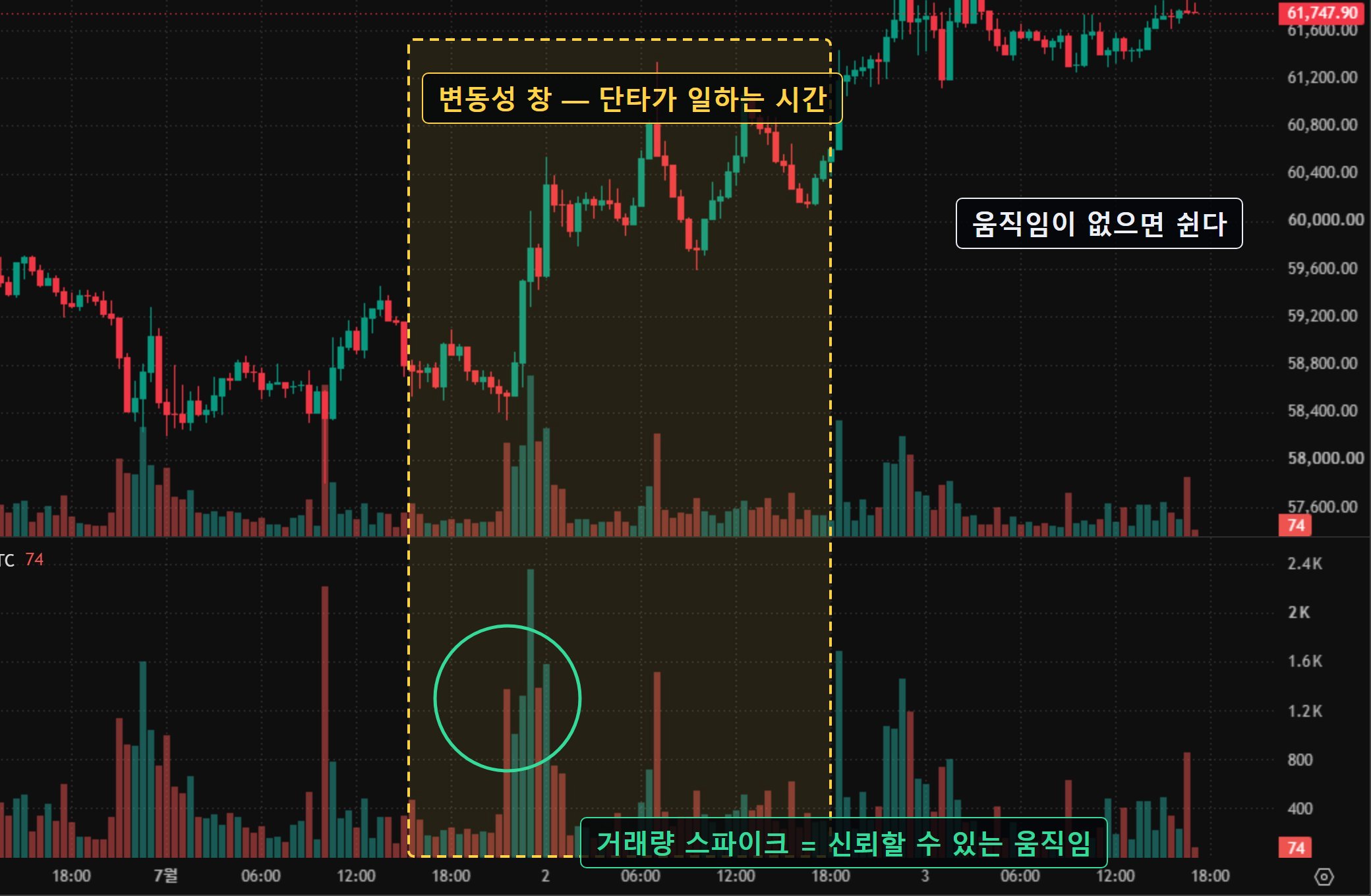
Note what the three structures have in common: in every one, the invalidation point is structurally defined before entry. The box boundary, the extreme of the extension, the swept level — the line that says 'if price comes back here, the scenario is wrong' already exists on the chart. A trade without that line — 'it just feels like it's going up' — is not a setup; it is an impulse. The concept of a setup itself — the four elements of condition, entry, invalidation, and target — is broken down in more depth in the day trading setups guide.
- Confirm the volatility window — first judge whether this is a session carrying liquidity and volatility. If the market is thin, the procedure ends here.
- Higher-timeframe context — check the trend direction and major support/resistance on the 4-hour and 1-hour charts. If the lower-timeframe signal points straight into a higher-timeframe wall, drop it from the candidate list.
- Mark your levels — pre-draw the box boundaries, prior extremes, and price zones where volume was concentrated on the 5–15 minute chart. This step is not about finding signals but deciding in advance where you will react.
- Wait for the trigger — wait to see whether one of the three structures actually appears at a marked level. If the level never comes, there is no trade.
- Compute invalidation and size — measure the distance to invalidation (%), then divide your allowed loss by that distance to back out position size. This calculation comes before the entry button.
- Log it — record which structure it was, whether the invalidation was honored, and what the costs were. A setup's statistics come from this log and nowhere else.
Stops and Risk-Reward — A Game of Being Wrong Often and Losing Small
Scalping is a game designed around being wrong often. Lower-timeframe signals carry a high noise ratio, so whichever structure you use, you will hit invalidation a substantial number of times. The survival condition for scalping is therefore not 'being wrong less' but cutting the size of each loss to a fixed, consistent amount when you are wrong.
Run the numbers. If BTC is holding a prior low of $64,870 while trading near $65,000, traders typically place invalidation just below that structure, around $64,740 — a stop distance of 0.4% from $65,000. On a $10,000 account, allowing 0.5% ($50) per losing trade means a notional position of $50 ÷ 0.004 = $12,500 — 1.25x the account in exposure. The tighter the stop, the larger the notional you end up holding for the same risk — which also means a single instance of overriding your stop becomes an account-scale loss.
Targets have to be realistic too. Drawing a 3% target on a setup with a 0.4% stop is not risk-reward design; it is wishful thinking. Lower-timeframe inefficiencies are short-lived, so scalp targets usually sit at the next level the structure allows — the prior extreme, the opposite boundary of the box — somewhere between 1R and 2R. The risk-reward is lower, but the structure compensates by stacking attempts, which means performance can only be judged over the sum of dozens of trades, never on any single one.
The most destructive pattern is refusing to take the stop on a scalp and holding it with a 'let's just watch it a bit longer.' If a $12,500 exposure designed around a 0.4% stop slides to -3%, the loss is not $50 but $370 — seven times the plan. With leverage on top, this mutation can end in forced liquidation (what is liquidation?). In scalping, the stop is not a negotiation — it is part of the setup.
Fees and Slippage — The Scalper's Real Opponent
The most underestimated variable in scalping is not the market — it is cost. Because the edge is small and turnover is high, the fees that are a rounding error in swing trading become the entire contest in scalping. At a 0.05% market (taker) fee, the round trip costs 0.1%. A setup with a 0.4% stop and a 0.6% target has an on-paper risk-reward of 1.5, but net of costs you make +0.5% when you win and lose -0.5% when you lose — the effective risk-reward collapses to 1.0. The setup is unchanged, yet fees just took a third of the edge.
Fifteen round trips a day means 1.5% of notional going out the door in fees. If your average notional runs 2x the account, that is 3% of the account leaking away in costs every single day. Over a month (20 trading days), that is 60% of the account — the starting point of the scalping calculation is that you have to generate an edge exceeding that number every day just to break even. This is why raising your limit (maker) fill ratio and checking your exchange fee tier flows through to P&L before entry technique ever does.
Slippage is the second opponent. Enter with a market order into a thin book and you get filled worse than the displayed price; in a violent move, even your stop order fills beyond its set level. On a design with a 0.4% stop, just 0.1% of slippage makes the realized loss 25% larger. The earlier principle of choosing your volatility window returns here — the sessions carrying liquidity are opportunities, yes, but above all they are the sessions in which costs stay under control as planned.
Traps and Limits — Overtrading, Revenge Trading, and Honest Arithmetic
Scalping's traps come not from technique but from the repeated-game structure itself. Overtrading is trades materializing not because a setup exists, but because you happen to be watching the screen. In a repeated game, every attempt is a cost event — an entry without a setup is paying fees while holding no edge.
Revenge trading is more destructive: the loop of re-entering at larger size right after a loss, driven by the urge to 'win it back' — the worst possible combination, in which exposure peaks at exactly the moment judgment is most clouded. The psychological mechanism and the rules for handling it get their own treatment in the trading psychology guide.
There is a pattern that shows up repeatedly in scalping logs: profits earned from planned setups during the volatility window get handed back through unplanned, boredom-driven trades after the market cools. The answer is rules, not willpower — a daily loss limit (e.g., stop at -2R), a daily cap on attempts, a forced break after hitting the target. If the limits do not exist as rules, the repeated game is always lost by whoever stays seated longer.
The limits deserve honest ink too. First, lower-timeframe inefficiencies are the most densely contested territory for bots and high-frequency algorithms, so an individual's edge is structurally thin — and even where it exists, there is no guarantee it persists. Second, scalping is labor-intensive — the recurring criticism is that measured against screen-watching hours, the hourly wage often comes out negative. Third, a good short-run result may be the product of variance rather than evidence of edge, so without a log of dozens of trades you cannot even determine whether you have one. Behind every story of a big account built by scalping stand many more accounts burned the same way — as the James Wynn case shows, high-leverage repeated trading tends to end not in a glorious equity curve but in a question of survival.
Whale Story Observations — The Scalping Environment Through the Trade Tape
The micro-flow scalpers read prints in trade data before it shows up in candles. A candle is a summary of an interval; the trade tape is the raw record of who is buying and selling aggressively at this exact moment. The large-trade tape on Whale Story's live tracker filters that raw record down to the big blocks — whether large market buys are printing back-to-back at the start of a breakout, whether sell prints are being absorbed at the top of a spike — the observations that decide how much trust a scalp setup deserves. A systematic method for reading trade data continues in the order flow and CVD guide.
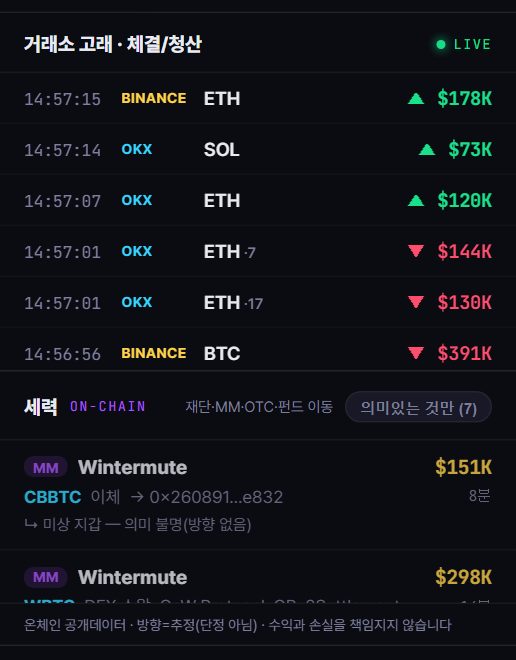
During sharp rallies, the suspected-top signals become a reference point. It is a tool that detects and logs moments when exhaustion signs have been observed after a short, sharp run-up — not a trade instruction, but a way to check whether the current moment resembles phases where the overextension snapback has been observed. Scalping is ultimately a game of environment — the habit of verifying the volatility window, fill quality, and overheating against measured data is what separates procedural scalping from scalping by feel.
The microstructure scalping deals in is territory you can verify with measured data on Whale Story. The large-trade tape on the live tracker prints the raw flow that precedes any candle summary — clusters of aggressive buys at the start of a breakout, sells being absorbed at the top of a spike — while the suspected-top signals automatically detect and log phases where exhaustion signs have been observed after a short, sharp run-up. In past observations, a recurring tendency has been confirmed: when large prints cluster inside a volatility window, candle ranges and slippage expand together — a measured illustration of this article's calculation that scalping's opportunities and its costs crowd into the same hours. Overlay the smart-money tracker feed and you can also check whether sharp moves in a given window coincide with movements from verified wallets. These are tendencies in past data only — no time window or signal guarantees profits.
FAQ
What timeframe should I use for scalping?
There is no single right answer, but traders commonly anchor context on the 1-hour and 4-hour charts and confirm triggers on the 5–15 minute chart. The 1-minute chart on its own is widely considered the hardest place to build an edge net of fees, given its noise ratio. What matters is not the specific minute count but the order of operations — higher-timeframe context comes first.
What are the best hours to scalp crypto?
In historical data, volatility and turnover tend to cluster around the U.S. equity open (13:30–16:00 UTC), around major U.S. economic data releases (typically 12:30–13:30 UTC), and at the European open (07:00–08:00 UTC). Conversely, the Asian late-morning hours and weekends often bring thin books, larger slippage, and more whipsaw. These are tendencies only — no time window guarantees profits.
Is scalping better than swing trading?
It is not a question of better or worse but of structure. Scalping harvests a small edge many times, at the price of heavy costs, discipline, and screen time; swing trading aims for one large move, at the price of patience and wider stops. A practical decision criterion: if your daily schedule cannot put you in front of the screen during the volatility windows, scalping is structurally stacked against you.
Do fees really matter that much?
In scalping, they are decisive. A 0.1% round-trip taker fee cuts the effective risk-reward of a 0.4% stop / 0.6% target setup from 1.5 to 1.0. At 15 round trips a day, 1.5% of notional leaves in fees daily, which is why your maker fill ratio and fee tier often flow through to P&L before entry technique does.
Can I enter scalps based on Whale Story signals?
No. Whale Story's trade tape and suspected-top signals are observation tools that detect and log market conditions — not a signal service that tells you when or which direction to enter. The data is material for checking a setup's credibility, nothing more, and trading decisions and their outcomes are entirely your own responsibility.