The Math of Leverage — Liquidation Distance, Isolated vs. Cross, Effective Leverage
Published 2026.07.01 · Updated 2026.07.06
People search for crypto leverage for one of two reasons — how high a multiplier is okay to use, and at what percentage they get liquidated. This piece answers both with a formula. It starts from a single line — the liquidation distance at N-times leverage is roughly 1/N — then works through the difference in what isolated and cross margin put up as collateral, and a procedure for calculating effective leverage, a number more honest than the slider. There is one illusion to clear away, too — leverage is not a button that multiplies profits but a dial that shrinks how wrong you are allowed to be, and no single 'right multiplier' exists.
- Net of maintenance margin and fees, the liquidation distance at N-times leverage is roughly 1/N. At 10x a move of about -10% ends the position, at 25x about -4%, at 50x about -2%.
- Actual liquidation always arrives before 1/N because of maintenance margin and fees. The higher the multiplier, the larger a share of your total room this gap consumes.
- An account's real risk is measured not by the slider multiplier but by effective leverage (sum of open position notional value ÷ total capital). An account at 5x on the slider can be riskier than one at 20x.
- In Whale Story's observed data from Hyperliquid, a tendency repeats: the longer a top wallet has survived, the lower it tends to keep its effective leverage. That is a confirmation of the structure, not a recommendation of any particular multiplier.
What Leverage Really Is — Not Borrowed Money, but a Narrower Margin for Error
Leverage is a mechanism that uses your margin as collateral to open a position with a larger notional value. Put in $1,000 and set 10x, and a $10,000 position opens; when price moves 1%, your margin moves 10%. You can learn that much from the exchange's front screen. The problem is that most people read this multiplier only as 'the side where profits get bigger.'
Structurally, what leverage actually adjusts is not profit — it is your margin for error. At 1x spot, your account survives even if price gets cut in half; at 10x the position is forcibly ended around -10%, at 25x around -4%. Raising the multiplier is the act of narrowing, by your own hand, the range within which your call is allowed to be wrong — and past a certain line, even the market's everyday chop falls outside that range. The rest of this article is nothing but the arithmetic of that one sentence.
The leverage slider is not a profit amplifier — it is a dial that shrinks how wrong you are allowed to be.
The Liquidation Distance Formula — You Only Survive the Inverse of Your Multiplier
The formula is one line. Setting fees and maintenance margin aside for a moment, the liquidation distance of an N-times position is roughly 1/N. The reasoning is just as simple — a 1% adverse move erases N% of your margin, so for 100% of the margin to vanish, price only needs to move 100/N%, the inverse of the multiplier. That is about -20% at 5x, -10% at 10x, -5% at 20x, -4% at 25x, -2% at 50x. Double the multiplier and the room you can survive is cut in half.
Plug in real numbers and the feel changes. Enter a 10x BTC long at $100,000 and the theoretical liquidation zone sits near $90,000 (-10%). From the same entry, 25x moves it up to $96,000 (-4%) and 50x to $98,000 (-2%). That is barely $2,000 below your entry — the liquidation price sits inside the range BTC covers in a day without any news at all. The machinery that actually executes the forced close is covered in What Is Liquidation?.
Exchanges trigger liquidation before your margin hits zero — the moment it falls below the maintenance margin ratio (say, 0.5%). Layer on entry fees and the maintenance-margin tiers that rise as positions get larger, and your real room is always thinner than 1/N. At 50x, factoring in just a 0.5% maintenance margin already wipes out a quarter of that '2% of room.' Memorize one thing — 1/N is an upper bound, not the actual distance.
Isolated vs. Cross — What Are You Putting Up as Collateral?
Isolated margin pledges only the margin you have assigned to that position. If it gets liquidated, the loss stops at the allocation and the rest of your account balance survives. In exchange, spare funds are not pulled in automatically, so the liquidation price forms close by. It is a structure that fixes one position's maximum loss up front.
Cross margin uses your entire account balance as shared collateral. The balance acts as a buffer and pushes the liquidation price further away — but by the same token, when things break down, one position drags the whole account in with it. It is a structure that flexibly recycles margin across multiple positions, and the trap is that the screen never quite shows you that what is pledged is effectively everything you have.
Put numbers on it and the difference sharpens. Say you have a $10,000 account and allocate $1,000 of margin to open a 10x position ($10,000 notional). On isolated, the collateral is only that $1,000, so the liquidation price forms around -10% from entry (earlier once maintenance margin is factored in), and even in the worst case the loss ends at the $1,000 you allocated. Open the same position on cross and the remaining $9,000 attaches as a buffer, pushing the liquidation price much further away — judging by the screen, it looks like you have become safer. But the price of that distance is a bigger pool to burn through: if price keeps moving against you, it is not $1,000 that melts down as collateral but the account's entire $10,000. A distant liquidation price and a small amount at risk are entirely different things, and cross's 'far liquidation price' is nothing more than the result of this trade. Defaulting to cross without understanding that exchange is the most common path by which a beginner's account empties in one shot.
Isolated draws a 'this is the most I will lose on this position' line at the position level; cross defers that line to the account level. When the liquidation price looks far away on cross, you have not become safer — you have pledged more money as collateral. Either way, the thing to check before the multiplier is 'what exactly is being held as collateral right now.'
Effective Leverage — Recalculated Across the Whole Account
The slider multiplier is just one position's nominal multiplier; it says nothing about the risk your account is carrying. An account's real risk is measured by effective leverage = sum of open position notional value ÷ total capital. If this number is the same, the shock a market move deals your account is similar no matter what the slider says.
- Add up the notional value (quantity × current price) of every open position. Add them as absolute values, longs and shorts alike.
- Divide that sum by your total capital (equity). The result is your effective leverage.
- Interpret it — effective 1x is the same exposure as spot; effective 3x means a 1% market move swings your whole account by about 3%.
- Recalculate every time you add to or trim positions. Effective leverage is not a fixed value — it keeps shifting with balance and price.
Compare two $10,000 accounts. Account A runs the slider at 20x with $1,000 of margin — $20,000 notional, effective 2x. Account B goes 'safe' at 5x on the slider but puts in $8,000 of margin — $40,000 notional, effective 4x. A's on-screen multiplier is four times higher, but B takes twice the hit to the account. If the market moves 5% against them, account A takes about -10% (-$1,000) and account B about -20% (-$2,000). The common fallacy — 'the multiplier is low, so I can size up' — breaks down at exactly this point.
The Math of High Multipliers — How Fees, Funding, and Volatility Compound
First, fees are charged on notional value, not margin. A round trip at a 0.05% taker fee costs 0.1% of notional — and on a 20x position, that is 2% of your margin. You start at -2% the moment you press the entry button, and at 50x you start at -5%. This is why high multipliers combined with frequent trading grind an account down regardless of direction.
Second, funding. Perpetual futures pass funding payments back and forth periodically depending on the long-short skew. Even 0.01% per interval is charged on notional value, so the longer a high-multiplier position holds on, the more the burden accumulates relative to margin — and in heavily crowded markets, this cost alone can visibly shave down your liquidation room. The mechanics are covered in What Is the Funding Rate? and Funding & Open Interest.
Third, volatility. Even BTC swings 3-5% in a day for no reason at all. The 4% of room at 25x sits inside that everyday range, and in fast markets there is tail risk on top — the order book empties out and liquidations fill worse than the marked price. The reason traders keep getting liquidated on the shake in the middle despite calling the direction right is not psychology, it is this arithmetic — and how that unfolds continues in Why You Get Liquidated.
Any content that answers this question with a specific number can safely be filtered out. The multiplier you can handle is an output, not an input — it is jointly determined by your stop distance, position size, and total capital. Flip the order — decide first how much you will lose on a single failed trade (1R), work backward from your stop distance to your quantity, and the multiplier follows as the result of that calculation. That procedure is covered in Risk Management. And the 1/N formula itself has limits — it is a simplification that leaves out maintenance-margin tiers, fees, and fill slippage. The formula is only a map, and the actual terrain is always rougher.
Whale Story's Observed Data — The Multipliers of Whales That Survive
Hyperliquid is an exchange where every position is public on-chain, so the notional value and collateral of top accounts can be observed directly rather than guessed at (What Is Hyperliquid?). The tendency Whale Story has repeatedly observed while tracking top wallets is simple — the longer a large account has survived, the more often it keeps its effective leverage low, regardless of the maximum multiplier the screen allows. This reads as a survival-first choice: keeping the liquidation price far from the current price so as not to get swept away by noise and tails.
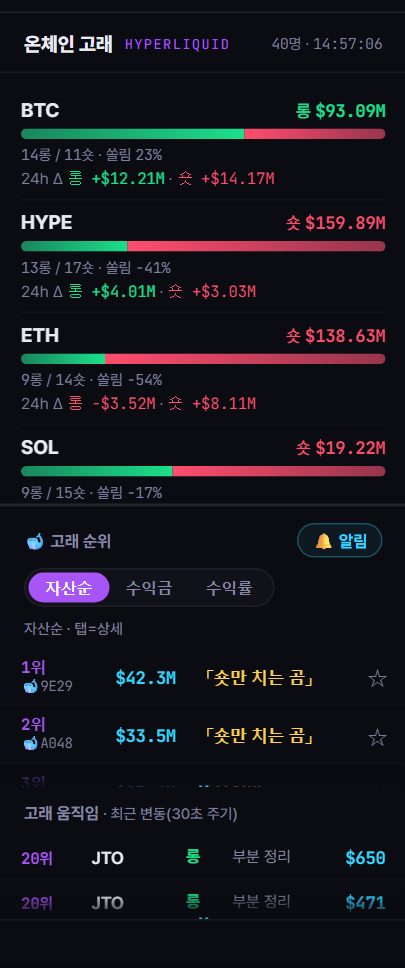
The other side of the sample is in the data too. Accounts that made their names on effective leverage in the tens of times have repeatedly been recorded getting wiped out by liquidation on mid-move volatility, even in stretches where their direction was right. This is not grounds for recommending any particular multiplier — it is an observation that this article's math, the multiplier determining your distance to liquidation, plays out exactly the same in real accounts. The one fact that does not change with the multiplier is that leveraged trading is a tool capable of losing your entire principal.
The math in this article can be checked against observed data on Whale Story. The whale rankings and whale levels in the live tracker show the notional value, collateral, and liquidation prices of Hyperliquid's top wallets as they are, so you can calculate for yourself where top accounts' effective leverage actually sits. In past observations, a tendency has repeated: the longer a large wallet had survived, the lower its effective leverage and the further its liquidation price stayed from the current price — while, on the flip side, the data also holds records of ultra-high-multiplier accounts getting wiped out on mid-move volatility regardless of direction. The volatility regimes in which suspected-top signals fire during sharp run-ups are precisely when thin-room, high-multiplier positions are at their most fragile, and the large-wallet movements in the smart-money tracker show the backdrop against which that volatility gets made. All of this is a tendency in past data only and guarantees nothing about the future.
FAQ
At 10x, do I get liquidated at exactly -10%?
No. -10% is a theoretical upper bound that excludes fees and maintenance margin. Exchanges trigger liquidation the moment your margin falls below the maintenance margin ratio, so actual liquidation comes earlier than that. The higher the multiplier, the larger a share of your total room this gap consumes, so the displayed room on a high-multiplier position should be treated as far thinner than it looks.
Which is safer, isolated or cross?
Neither can be called always safer. Isolated fixes one position's maximum loss but keeps the liquidation price close, while cross weathers more with your whole balance but exposes the entire account when things break down. The right order is to check 'what is being held as collateral right now' before you check the multiplier.
So what multiplier is right in the end?
There is no single answer. The multiplier you can handle is an output jointly determined by your stop distance, position size, and total capital. Decide first how much you will lose on a single failed trade, work backward from your stop distance to your quantity, and the multiplier follows naturally — and at the account level, the key is managing effective leverage (sum of notional value ÷ total capital), not the slider number.
If I don't use leverage, is there no liquidation either?
Holding spot carries no forced liquidation. In futures, however, even a 1x position sits inside the maintenance-margin structure, so liquidation exists in theory — and because of crypto's inherent volatility, the possibility of losing principal never disappears in any case. Leverage is simply the variable that multiplies the speed and size of that loss.