On-Chain Whale Tracking — A Methodology for Netflow, Smart-Money Wallets, and Signal Reading
Published 2026.07.06
You probably found this page hoping that following whale wallets would let you move one step ahead of the smart money. That is half right — on-chain data is a ground-truth record with no disclosure lag and no estimation, and there have been repeated cases where large moves shook the market. The other half is an illusion. The simple formula "exchange deposit = sell" is wrong half the time, and following a mislabeled wallet turns the data into poison. As the graduation piece of this curriculum, this article covers the precise limits of netflow interpretation, how smart-money wallets actually get identified, and a procedure for reading moves through three factors: amount, actor, and destination. By the end, you should be able to look at a single large-transfer alert and classify for yourself whether it is signal or noise.
- The chain records the facts of a move — addresses, amount, timestamp — block by block, but it records neither identity nor intent. On-chain tracking boils down to two jobs: labeling, which attaches identities to addresses, and interpretation, which reads what a move means.
- "Deposit = possible sell, withdrawal = holding intent" is only a starting point. Exceptions abound — derivatives margin deposits, inter-exchange rebalancing, custody transfers — so without sizing the move in relative terms and confirming follow-through, it remains a hypothesis.
- Signals are read through three factors: amount, actor, and destination. The same dollar amount carries completely different weight depending on whether it is the first deposit of unlocked tokens or a market maker's routine rotation.
- The most common failures are internal-transfer false positives and label errors. Trades inside an exchange never hit the chain, so whether a deposit actually turned into a sell can never be confirmed from on-chain data alone.
The Chain Cannot Hide — What the Public Ledger Records
A blockchain records every move on a public ledger, complete with sending address, receiving address, amount, and timestamp. In equities, changes in institutional holdings surface up to 45 days late through quarterly 13F filings; on-chain moves become a record anyone can verify the moment a block confirms — roughly every 10 minutes on Bitcoin, roughly every 12 seconds on Ethereum. Public, ground-truth, zero-lag. Those three properties make on-chain data unlike any other market data.
What the ledger records, however, is addresses and amounts only — not identity, not intent. Nothing on the ledger says whether an address starting with 0x is a foundation allocation, an individual whale, or an exchange cold wallet. That is why on-chain whale tracking splits into two jobs. First, labeling and verification — attaching an identity to an address. Second, interpretation — reading what a confirmed actor's move actually means. The rest of this article is the methodology for those two jobs.
Visible — wallet-to-wallet transfers, contract interactions, timestamps and amounts, a wallet's entire history. Invisible — trades inside centralized exchanges (fills that happen within an exchange live only on its off-chain books), the terms of OTC deals, and intent. In short, the deposit is a fact; the sell is an inference. The moment you blur that line, on-chain analysis turns into fiction.
Exchange Netflow — Reading Deposits and Withdrawals, and the Precise Limits
Exchange netflow is the coins that flowed into exchanges over a period minus the coins that flowed out. The basic frame is simple. To sell on a centralized exchange you first have to move coins onto it, so a large deposit reads as a possible sell, while a withdrawal reads as holding intent — no plans to sell for now. Sustained net inflows read as accumulating potential sell pressure; sustained net outflows read as shrinking exchange reserves. That is the textbook reading. The basics are covered in What Is On-Chain Netflow?.
The problem is that this frame has more exceptions than you would think. Deposits that are not sells — margin (collateral) deposits for futures positions, inventory rebalancing between exchanges, a market maker's routine inventory rotation, transit for OTC settlement. Withdrawals that are not holding — moves into staking or DeFi collateral, bridging on the way to another exchange, transfers to a custodian. In crypto especially, where derivatives dominate flow, a large share of big deposits are position collateral, not sells. Calling direction off a single deposit means ignoring every one of these exceptions.
Say BTC is at $100,000: a 3,000 BTC deposit is $300 million. The number looks enormous, but on a day when BTC spot volume tops $10 billion, that is 3% of daily volume — a size the market can absorb. Conversely, if an altcoin sees 3% of its circulating supply deposited in one shot and that equals half the coin's daily volume, the weight is incomparable even at a smaller dollar figure. The yardstick is not the absolute amount but three denominators — relative to circulating supply, relative to daily volume, relative to exchange reserves.
Past observations show both sides of this frame well. In the summer of 2024, roughly 50,000 BTC moved from the labeled wallets of the German state of Saxony onto exchanges in staged deposits over several weeks; in that case the deposits did lead to actual selling, and market pressure was observed throughout the period — an episode that left little room for interpretation, because both the actor (government-seized coins) and the destination (exchange spot wallets) were clear. By contrast, the large moves of Mt. Gox repayment coins that same year were largely procedural — custody and distribution transfers — yet the moves themselves were translated into sell panic and the market reacted first. The same "large move" cuts either way depending on actor and context.
How Smart-Money Wallets Get Identified — Labeling and Cross-Verification
So how does a label like "this address belongs to that player" come to exist? The starting point is securing seed addresses. Foundation and team vesting contracts expose their recipient addresses in code; exchanges disclose major wallets through proof-of-reserves and similar programs; and legal disclosures, post-hack tracing, and the back-tracing of major liquidation events also yield confirmed addresses. This small set of addresses with certain identities is the root of all labeling.
Expanding from seeds into wallet clusters is clustering. On Bitcoin, the common-input heuristic — the inputs of one transaction share an owner — provides clues; on Ethereum-style chains, it is behavioral fingerprints: shared gas-funding addresses, timing and amount patterns of deposits and withdrawals, repeated use of the same bridge and DeFi combinations. The footprint of a wallet cluster quietly absorbing supply at a specific price band is also the work of confirming, with on-chain ground truth, the accumulation you used to infer from charts — the data version of what Wyckoff's accumulation and distribution was describing.
The core principle is to never confirm a label on a single piece of evidence. Only when at least two independent lines of evidence overlap — such as a vesting-contract receipt matching disclosed allocations — can a label be treated as verified. Even commercial label databases keep reporting problems: stale labels, wallet ownership changes, custodian wallets mistaken for individual whales. Standard practice is to treat labels as having an expiration date and to re-verify any wallet whose behavior pattern changes.
The Three Factors of Signal Reading — Amount, Actor, Destination
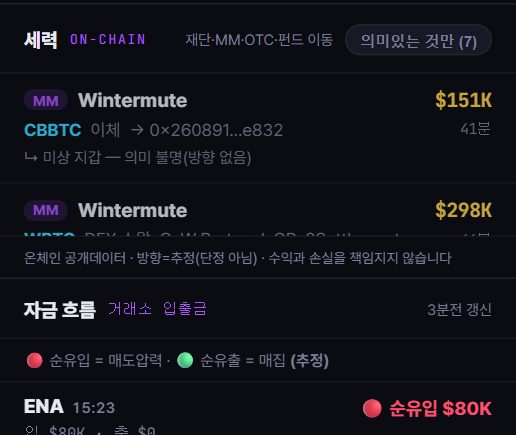
Once a move is detected from a verified wallet, the reading begins. There are three criteria. Amount — not the absolute figure but the relative size against the three denominators above (circulating supply, daily volume, exchange reserves), plus how unusual it is versus the wallet's typical transfer size. Actor — how strongly the label is verified, and the track record (did this wallet actually sell after past deposits, or only ever use them as collateral?). Destination — even at the same exchange, the interpretation changes completely depending on whether the coins landed in a spot wallet or as derivatives-exchange margin, or in a fresh cold wallet, DeFi, or a custody address.
Run the numbers. If an early investor's vesting wallet deposits 15 million tokens received at $0.40 apiece (3% of circulating supply) into an exchange spot wallet for the first time near $2.00, that is $30 million of unlocked supply sitting at +400% unrealized moving into a sellable position. If, on the other hand, a market-maker-labeled wallet is rotating the same $30 million between several exchanges every day, the information value of the identical amount is close to zero. It is not the amount — actor and context decide the weight.
- Detect and check the raw transaction — do not rely on the alert; open the raw transaction (sender, receiver, amount) yourself on a block explorer.
- Filter internal transfers — if both addresses carry the same exchange's label, it is most likely a rebalance. Roughly half of all moves get filtered out here.
- Size the amount in relative terms — compute the ratios against circulating supply, daily volume, and exchange reserves, plus the multiple versus the wallet's typical transfer size.
- Confirm the actor — check that the label rests on at least two lines of evidence, and whether this wallet's past deposits ever led to actual selling.
- Classify the destination — spot exchange, derivatives margin, fresh cold wallet, DeFi, or custody. Keep the sell hypothesis only when the coins went to a spot exchange.
- Follow through and invalidate — if within 24–72 hours of the deposit there is no sign of selling in exchange reserves and the trade flow, or the coins are simply withdrawn again, reject the sell hypothesis and reclassify the move as collateral or a rebalance. Logging those after-the-fact reclassifications is what turns reading accuracy into an asset.
Just as chart trading has stop-losses, on-chain reading needs invalidation conditions. "It got deposited, so price falls" is a narrative with no invalidation. "It got deposited; if selling is confirmed within N hours, treat it as pressure; if it gets withdrawn again, drop the hypothesis" — that is verifiable analysis. Whether you have defined in advance when you will admit you were wrong is what separates analysis from fiction.
The Traps — Internal Transfers, Label Errors, and On-Chain's Fundamental Limits
The first trap that breaks readings in practice is the internal-transfer false positive. An exchange's routine housekeeping — moving inventory from a cold wallet to a hot wallet — still gets translated into "massive whale deposit" and spreads through alert services to this day. Most of these are filtered out by their telltale features — large round-number amounts, a regular rhythm, both sides sitting in the same exchange cluster — but on newer chains with thin label coverage, the false-positive rate climbs.
① Are both the sender and the receiver exchange-labeled (internal transfer or rebalance)? ② Does the move break the wallet's usual rhythm, or is it the same rotation it always runs? ③ Does it coincide with a scheduled event — a token unlock, a repayment, an airdrop? ④ Has actual selling been confirmed after the deposit? If even one of these four has not been checked, that alert is still noise, not signal.
The second is label errors and over-interpretation. A single label that mistakes a wallet whose ownership has changed, or a custodian's address, for an individual whale contaminates the entire reading. Cases like the Mt. Gox repayment moves — procedural transfers translated into sell panic that moved the market first — show that it is not the data but the narrative about the data that can move price. And when that narrative turns out wrong, the reversal comes with it.
Finally, the fundamental limits, stated honestly. The chain does not show intent; it carries huge blind spots in exchange internals and OTC; and in regimes where derivatives drive price, the explanatory power of spot moves itself degrades. Violent moves in leveraged markets can happen purely from cascading position liquidations, with no on-chain signal at all. On-chain data is an input that adjusts probabilities, not a prophecy that guarantees direction — and the risk of losses from decisions based on it rests entirely with the person who made them.
The chain never lies — the lies always come from the interpretation.
Whale Story in Practice — Watching 168 Verified Wallets Around the Clock
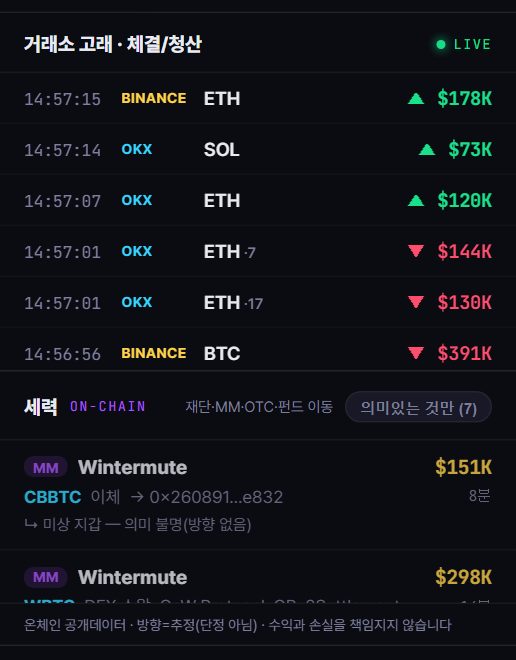
The methodology in this article is also the system Whale Story actually runs. The smart-money tracker curates only the 168 smart-money and institutional wallets that passed cross-verification, watches them around the clock, and when a move occurs, filters out internal transfers before broadcasting it to the real-time feed. Every signal is a detection and observation result, not a trade instruction — the reading and the decision are done by each reader, following the procedure in this article.
Fitting for a graduation piece, let us fold the whole curriculum into one sentence. The liquidity that SMC guesses at is crossing over into derivatives ground truth (liquidation prices, average entries), and the Composite Man that Wyckoff imagined is crossing over into on-chain labeling — each moving into the territory of data. Reading the chain's answer to "who moved" on top of what a transparent derivatives ledger like Hyperliquid answers about "where the positions are stacked" — that is this site's methodology, and how to use whale data, and how not to, continues in The Whale Playbook.
You can watch this article's methodology running live, on real data, at Whale Story. The smart-money tracker watches 168 cross-verified smart-money and institutional wallets around the clock and broadcasts only the moves that survive the internal-transfer filter to the smart-money feed on the live tracker. Past observations have recorded both outcomes: verified wallets depositing to exchanges followed by heavy selling on the trade tape and visible price pressure — and deposited coins quietly withdrawn again with nothing happening at all. Exactly the line this article draws: the deposit is a fact, the sell is an inference. In a sharp rally, you can open the suspected-top signals alongside it to cross-check whether on-chain moves coincide with observed market overheating. All signals are detection and observation results only and do not recommend trades in any direction.
FAQ
Where can I find whale wallet addresses?
Block explorers' top-balance lists, commercial label databases, and foundation vesting contracts and disclosures are the starting points. Label errors and ownership changes are common, though, so you need to verify each address yourself with at least two independent lines of evidence. Whale Story's smart-money tracker is an observation tool that curates and displays only the wallets that passed this verification.
Does a large deposit to an exchange make the price drop?
It cannot be assumed. In past observations, market pressure appeared in cases where a verified actor's coins actually got sold, but a large share of big deposits were margin deposits, inter-exchange rebalancing, or custody transfers with nothing to do with selling. Only after checking amount, actor, and destination — and then seeing actual evidence of selling — can a deposit be treated as pressure.
Can I trade on on-chain data alone?
It is not recommended. On-chain data cannot see trades inside exchanges or OTC deals, and derivatives-driven violent moves happen without any on-chain signal. On-chain is one input among many; it only becomes meaningful when combined with market structure, derivatives metrics, and risk management. No data eliminates the possibility of loss.
Are netflow figures the same everywhere?
No. Netflow is aggregated based on each provider's coverage of exchange address labels, so the figures differ from one provider to another. Rather than trusting the absolute values, use netflow to check the direction of the trend and to spot unusual spikes — and for large moves, the accurate approach is to verify the raw transaction yourself on a block explorer.